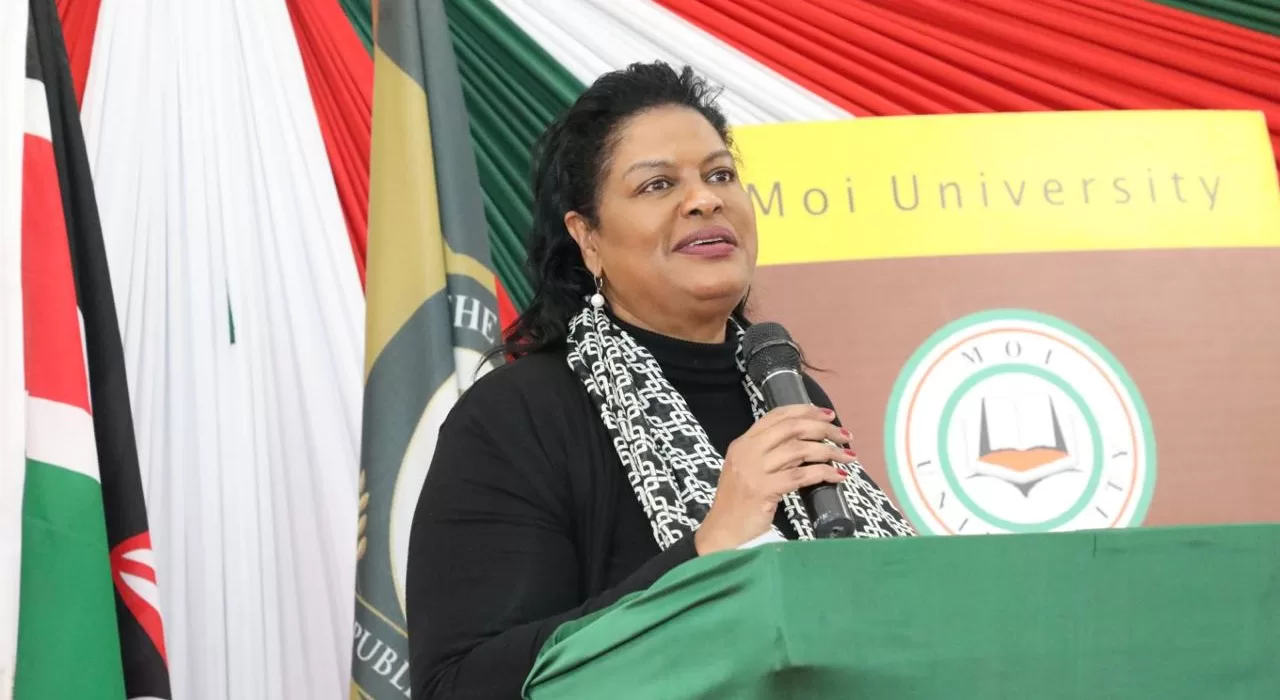
The Supreme Court of Kenya continued its nationwide outreach initiative today with a public lecture aimed at demystifying its work and engaging the academic community on its evolving jurisprudence.
Delivering the lecture at Moi University’s School of Law in Eldoret, Supreme Court Judge Njoki Ndung’u emphasized the need for open dialogue between the Judiciary and the public regarding critical decisions made by the apex court, especially in the field of criminal law.
“It is very difficult for Supreme Court judges to engage the public other than through their judgments,” Justice Ndung’u noted. “We felt that engaging academia and scholars is the best way in which we can share what we have been doing and have conversations around the decisions that we have been making.”
The lecture, titled “The Supreme Court of Kenya’s Evolving Jurisprudence on Criminal Law,” was part of the Supreme Court Lecture Circuit Series, a public education initiative launched in 2024 to improve public understanding of the Court’s role and decisions.
Justice Ndung’u’s lecture further explored how the Supreme Court has shaped Kenya’s criminal law through a series of key rulings. Topics included judicial discretion in sentencing, Article 50 constitutional rights, the right to a fair trial, extradition, and prosecutorial powers of the Office of the Director of Public Prosecutions (ODPP).
She examined how the Court has sought to strike a balance between the rights of individuals and the interests of the state, while also contributing to legal clarity and reform.
A significant portion of the lecture was dedicated to the controversial Muruatetu decisions, which initially declared the mandatory death sentence unconstitutional, leading to widespread confusion about the broader application of the ruling.
Justice Ndung’u clarified that while the original Muruatetu I decision limited judicial discretion in capital cases, the follow-up ruling Muruatetu II expressly stated that it did not invalidate all mandatory or minimum sentences across Kenyan statutes.
“The Court reiterated that Muruatetu cannot be the authority for stating that all provisions of the law prescribing mandatory or minimum sentences are inconsistent with the Constitution,” she said.
On Judicial Accountability in Sentencing, the Judge emphasized that sentencing guidelines can play a crucial role in promoting accountability among judges without stripping them of discretion. However, she acknowledged that mandatory provisions and statutory limits still constrain judges in many cases.
“Depending on the detailed provisions involved, determinate sentencing combined with sentencing guidelines can concentrate the determinations of sentence length in the court,” she explained.
The event drew students, legal scholars, and members of the public eager to engage directly with the Judiciary on complex legal developments. It marks another step by the Supreme Court to improve transparency and public engagement through open forums beyond courtrooms.