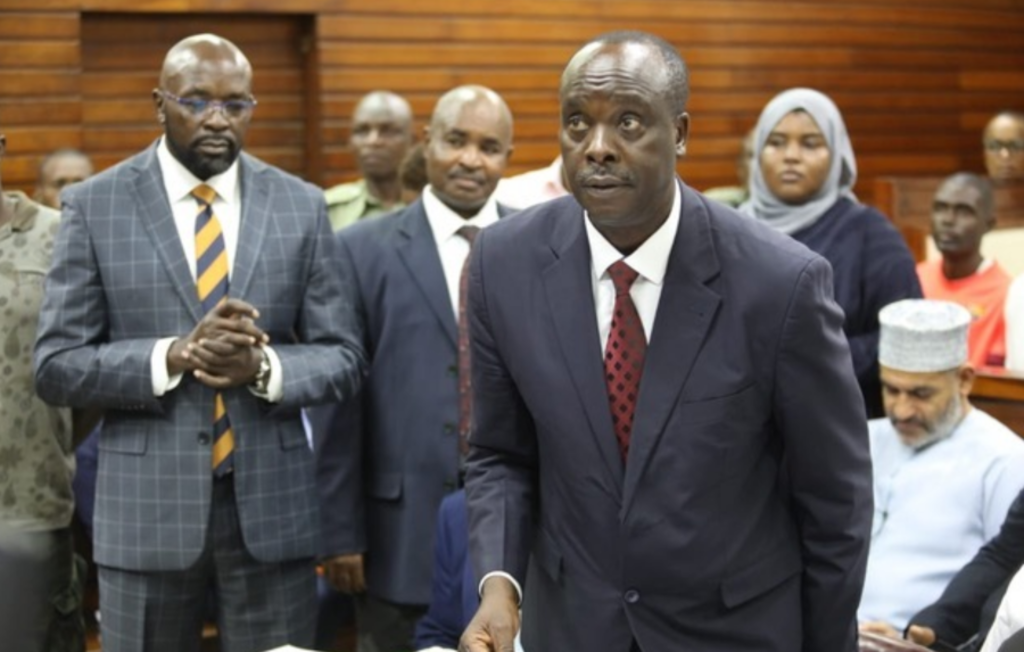
Former Law Society of Kenya (LSK) President Nelson Havi has filed an application seeking the disqualification of three High Court judges appointed to preside over seven consolidated petitions calling for the removal of all Supreme Court judges, including Chief Justice Martha Koome.
The panel in question Justices Charles Kariuki, Lawrence Mugambi, and Bahati Mwamuye was constituted by Chief Justice Koome herself, a move Havi argues constitutes a conflict of interest, given that she is one of the petitioners in the case.
In his application, filed under a certificate of urgency, Havi contends that it was unlawful for Chief Justice Koome to assign judges to hear matters in which she is personally implicated. He specifically points to Nairobi Constitutional Petition No. E083 of 2025, in which Koome challenges her own removal, as evidence of this conflict.
“I seek that Justices Kariuki, Mugambi, and Mwamuye recuse themselves from further proceedings in the seven consolidated petitions,” Havi states in the application.
He argues that the matter should instead be referred to Deputy Chief Justice Philomena Mwilu, who should appoint a new bench composed of judges not previously involved and not selected by the Chief Justice.
“The petition should be referred to the Deputy Chief Justice to appoint an uneven number of High Court judges excluding Justices Kariuki, Mugambi, and Mwamuye to hear and determine the consolidated cases,” Havi proposes.
In addition to CJ Koome’s case, Havi is also challenging the suitability of the current bench to hear petitions filed by six other Supreme Court judges: Deputy Chief Justice Mwilu, Mohammed Ibrahim, Smokin Wanjala, Njoki Ndung’u, Isaac Lenaola, and William Ouko.
The dispute originates from a case filed on February 20, 2025, in which the Chief Justice, her deputy, and five other Supreme Court judges moved to the High Court in Nairobi to contest the Judicial Service Commission’s (JSC) authority and process in handling the removal petitions.
Following this, the three judges currently under scrutiny Kariuki, Mugambi, and Mwamuye issued conservatory orders in all seven related matters, temporarily barring the JSC from considering the petitions seeking the judges’ removal.
Havi now claims that this prior involvement undermines the judges’ ability to remain impartial.
“Their prior decisions create a perception of bias. They cannot be seen as neutral arbiters in these petitions,” he argues.
He also emphasizes that the significance and constitutional weight of the petitions require a larger, more representative bench.
“The magnitude of these claims calls for a broader bench five or seven judges with diverse legal philosophies, reflecting Kenya’s diversity and ensuring gender balance,” said Havi