By: Vivian Navate
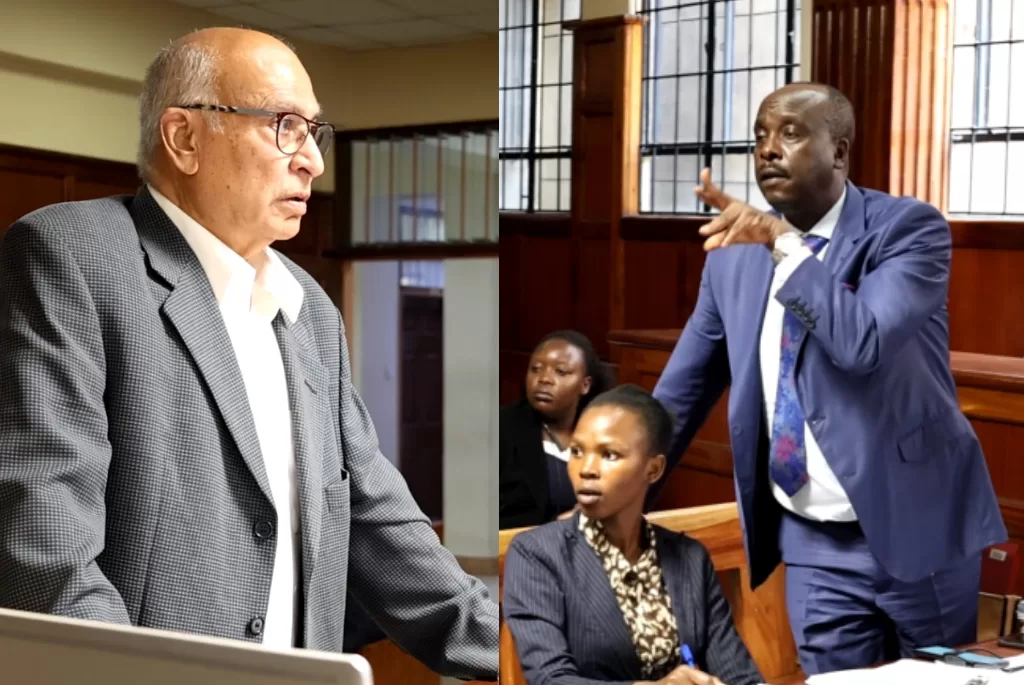
The succession dispute over the estate of the late businessman Balkrishna Ramji Haribhai Devani unfolded before Magistrate Rose Ndombi at the Milimani Law Courts, with his brother, Hasmukh Ramji Devani, taking the stand and facing a rigorous cross-examination over a contested will distributing Pelikan Signs Limited and other prime properties.
Testifying before the court, Hasmukh told the magistrate that the deceased, his elder brother, died on 7 June 2019 after a prolonged battle with leukemia and had been receiving treatment at Aga Khan Hospital.
He said that before his death, Balkrishna informed him and his wife that he was “reorganising his affairs,” which he understood to mean arranging succession matters.
“I was not consulted on the will at all. I did not participate in its drafting,” Hasmukh testified.
He told the court that after Balkrishna’s death, advocates from the firm of Dalli and Inamdar contacted him and invited him to attend the reading of the will on 19 June 2019 at their offices .
According to Hasmukh, the meeting was attended by three trustees, the widow Sudha Devani, two daughters of the deceased and representatives of the law firm.
“The reading was peaceful. There were no objections raised by anyone present,” he told Magistrate Ndombi.
Hasmukh said the advocates explained that the will dealt strictly with Kenyan assets, while overseas properties had been allocated to the eldest daughter, Shilpa Devani, outside the Kenyan will.
He testified that shares in Pelikan Signs Limited were bequeathed to Kalpa Chandarana Devani, with provisions put in place to ensure the widow was adequately provided for.
The court heard that the family home in Kileleshwa was left to Sudha Devani, while other properties, including plots near Nyayo Stadium and along Mombasa Road, were allocated to another daughter, Dinta Devani. Additional plots and residual cash, after settling expenses, were also directed to Kalpa.
To support his evidence, Hasmukh produced handwritten notes he said he made during the will reading, as well as a stamped copy of the will issued to him by the advocates.
“My notes show the date, time, who was present and a summary of what was read,” he told the court.
However, during cross-examination by lawyers Martina Swiga and Danstan Omari, Hasmukh’s testimony came under sharp scrutiny.
He admitted that although there were five brothers in the family, he was not the closest to the deceased.
“Not really. He was closer to my elder brothers,” he said, naming Arvind, Mahendra and Arun.
Swiga put it to the witness that it was not the advocates who decided who attended the will reading, but that Kalpa’s husband had written to the law firm requesting Hasmukh’s invitation.
“I received the invitation from the lawyers. I do not know what communications took place between them and family members,” Hasmukh responded.
He also confirmed that none of the other brothers attended the will reading, but said he did not know why.
“I assumed the advocates handled the invitations,” he said.
On whether he benefited from the will, Hasmukh was categorical.
“I have no personal interest in this estate. I am not a beneficiary,” he told the court.
When questioned on who was responsible for debts, funeral expenses and other liabilities of the estate, Hasmukh said he could not interpret the legal clauses of the will.
“I am not a lawyer. From what I understood at the reading, liabilities were dealt with on a property-by-property basis,” he said, adding that funeral arrangements in Hindu families are often handled collectively.Pressed to state who benefited most from the estate, Hasmukh declined.
“I cannot analyse my brother’s intentions or compare the value of the properties,” he said.
Lawyer Danstan Omari later questioned him on alleged earlier wills and the authenticity of signatures on documents produced in court. Hasmukh said he was not a handwriting expert and could not authenticate signatures, but noted that one signature attributed to the widow did not resemble what he knew.
“From what I have seen before, it did not look like her handwriting,” he said.
He confirmed that he recorded a statement with the Directorate of Criminal Investigations on 12 October 2023 and acknowledged that a person could change a will at any time before death.
“If there was a later valid will, then legally it would override the earlier one,” he testified.
Throughout the proceedings before Magistrate Ndombi, Hasmukh maintained that his role was limited to attending the will reading and recounting what transpired.
“I am only here as a witness to what I saw and heard,” he told the court.
The matter continues tomorrow, 28th January as key witness will be called to the stand.