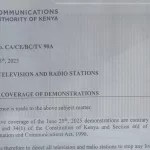
The Communications Authority of Kenya (CA) has defended its decision to bar live coverage of the June 25 anti-government protests, arguing in court that the directive was a lawful and necessary response to protect national security and curb the spread of incitement.
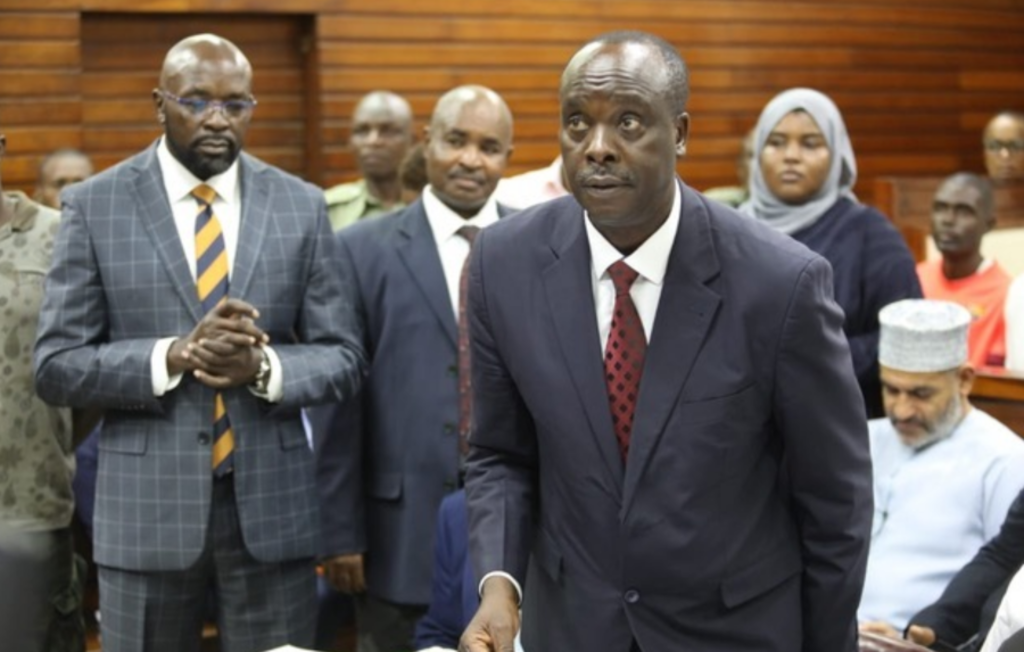
In a response filed before the High Court, CA Director General David Mugonyi, through an affidavit, asserted that the directive did not amount to censorship, but was a targeted measure to address live broadcasts being misused to fuel violence and public disorder.
“The directive was not a blanket ban on media coverage,” the affidavit reads. “It only applied to live coverage, which was being misused to incite violence and escalate unrest.”
The CA acknowledged that Article 34 of the Constitution guarantees media freedom but stressed that this right is not absolute. Citing Article 33(2), the Authority argued that freedoms of expression and the press do not extend to incitement to violence, hate speech, or the advocacy of hatred.
According to the CA, several broadcasters failed to implement profanity delay mechanisms, which led to unfiltered, graphic, and inflammatory content being aired in real time. The directive merely required a short broadcast delay to allow editorial control, the CA explained.
The regulator cited incidents of violence, looting, and arson in Nairobi, Thika, and Nakuru including the burning of Kikuyu Law Courts and the Kikuyu Police Station as consequences of uncontrolled live broadcasting during volatile protests.
The Authority further argued that its directive aligns with international best practices, noting that countries such as the U.S., U.K., and India also permit temporary broadcast restrictions during national emergencies or civil unrest.
Citing Section 46L of the Kenya Information and Communications Act, the CA emphasized that broadcasters are required to uphold responsible programming, accuracy, impartiality, and balanced coverage on controversial matters.
Represented by Koskei Mond Advocates LLP, the CA insisted that the petitioners challenging the directive had failed to show how their rights were violated, maintaining that public safety and national stability must take precedence.
“The directive was not censorship,” CA argued. “It was responsible regulation in a time of crisis.”
The matter is scheduled to be mentioned again on October 27 before Justice Chacha Mwita for further directions, including possible consolidation of similar petitions filed by other parties such as the Kenya Union of Journalists (KUJ