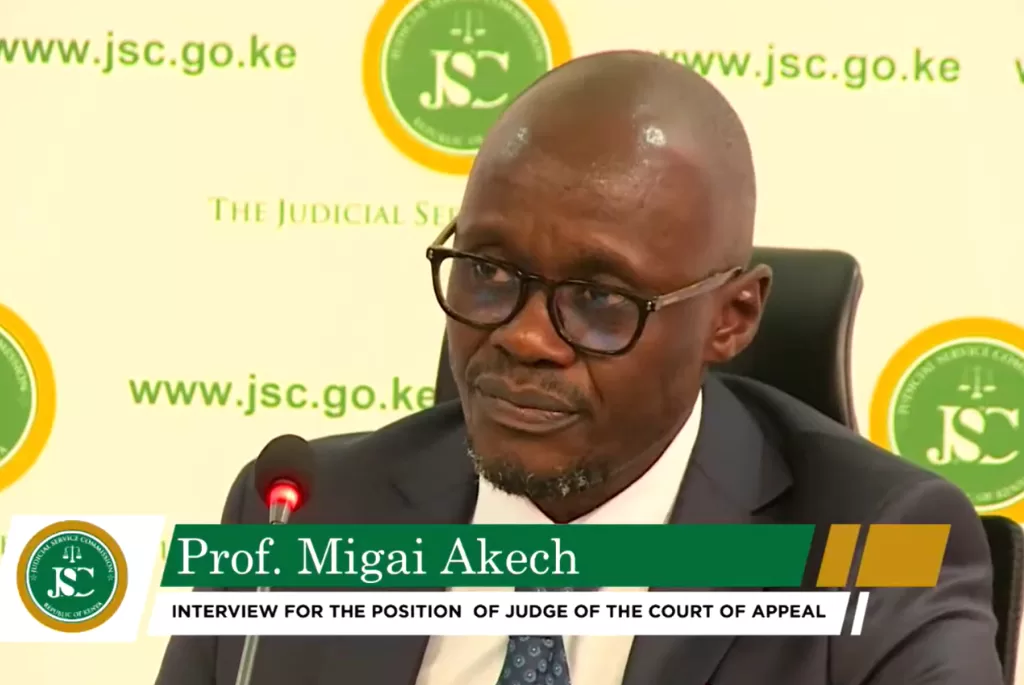
The Judicial Service Commission has kicked off interviews to fill vacancies at the Court of Appeal, with constitutional law scholar Professor Migai Akech becoming the first candidate to face the panel.
During the session, the commission put Professor Akech to task over a sensitive constitutional issue: how Cabinet Secretaries should be removed from office. Commissioners observed that while the Constitution sets out grounds for removal, it is silent on the exact procedure the President should follow, raising the question of whether a dismissed Cabinet Secretary is entitled to due process.
Professor Akech responded that the Constitution must be read in a manner that allows for an effective executive. He argued that the President must have sufficient latitude to appoint and relieve Cabinet Secretaries in order to govern effectively, describing such decisions as inherently political rather than administrative.
He told the panel that Cabinet appointments cannot be equated to ordinary employment relationships, insisting that the due process standards applicable to regular employees should not automatically apply to political appointees. According to him, the President must be free to decide whom to work with and whom to let go, without being constrained by rigid procedures borrowed from employment law.
Despite his long-standing reputation as a defender of human rights and constitutionalism, Professor Akech maintained that insisting on employment-style protections for Cabinet Secretaries could weaken executive efficiency. He stressed that political accountability operates differently from employer–employee relations and requires a distinct constitutional approach.
“We must have an effective executive,” he said, warning that over-judicialising political decisions could undermine the ability of the President to discharge constitutional responsibilities.
On the question of public participation, Professor Akech noted that while it cuts across all aspects of public life, it remains a subjective concept in practice. He cited the Building Bridges Initiative case as an illustration, pointing out that even judges differed sharply on what amounted to sufficient public participation.
He argued that courts can enhance public participation without frustrating legislative processes by developing clearer, context-specific indicators rather than rigid, one-size-fits-all tests. In his view, such an approach would balance democratic inclusion with institutional efficiency.
Addressing concerns about workload and performance, Professor Akech told the commission that he has authored more than 80 academic articles and expressed confidence in his capacity to manage the heavy docket of the Court of Appeal if appointed.