By: Vivian Navate
As Kenya steps into 2026, one thing is clear: the Judiciary played a defining role in shaping the country’s governance in 2025. Over the past year, courts repeatedly interpreted the Constitution at moments of political tension, public protest, and institutional dispute. From the Presidency to Parliament, from policing to elections and digital freedoms, their rulings put judges at the centre of national conversation and at times, controversy.
Police accountability and citizens’ right to protest were among the year’s most pressing issues. In landmark rulings, the High Court declared that the State acted outside the law when police used excessive force during demonstrations, including live ammunition and arbitrary arrests. Courts also awarded compensation to families affected by unlawful killings and detentions, sending a strong message that security cannot override the law or human rights. These decisions underscored that accountability is not optional, even in moments of unrest.
At the same time, the courts tackled digital freedoms. The High Court suspended provisions of the Computer Misuse and Cybercrimes Act that criminalized so-called “false” or “misleading” information. Petitions from journalists, activists, and public-interest groups argued that the law could be used to silence legitimate criticism of government. In response, the court’s decision was widely seen as a defence of media independence and freedom of expression, protecting Kenyans from prosecution for opinions or reporting that challenged power.
Political power disputes were also placed under judicial scrutiny. One of the most sensitive cases saw a three-judge High Court bench rule that the National Assembly Speaker acted unconstitutionally when declaring which coalition held majority status. The court found that Azimio la Umoja had more members than Kenya Kwanza at the time, contrary to the Speaker’s declaration. Filed by ordinary citizens, the case sparked national debate over parliamentary discretion and reinforced the idea that even high-level political determinations are subject to constitutional law.
Similarly, another High Court bench examined the recruitment process for members of the Independent Electoral and Boundaries Commission. While the court upheld the appointments, the case highlighted concerns about transparency and public confidence in electoral institutions, keeping electoral integrity firmly in the public eye. Meanwhile, petitions challenging the legality of Deputy President Kithure Kindiki’s assumption of office after political realignments showed how judicial oversight has become central to leadership disputes a reflection of citizens increasingly looking to the courts to resolve political uncertainty.
Several single-judge rulings also captured national attention. The High Court suspended parts of the Cybercrimes (Amendment) Act that critics said could weaken investigative journalism and whistle-blowing. It also temporarily stopped construction of a proposed mega-church within State House grounds, following petitions that argued the project conflicted with the Constitution’s secular character. In addition, a presidential panel formed to compensate protest victims was declared unconstitutional, with the court noting that such responsibilities belong to statutory human-rights institutions, not ad-hoc executive committees.
The courts also engaged with national representation and data integrity. In Garissa, the High Court annulled flawed 2019 census results in northern Kenya and ordered a repeat count a rare intervention likely to influence constituency boundaries, resource allocation, and development planning in the region.
Judicial independence remained a constant theme. Courts reaffirmed that the Judicial Service Commission holds sole authority over judicial appointments and clarified that administrative tribunals fall under the Judiciary rather than the Executive. These rulings reinforced separation of powers and protected the courts from political interference.
Perhaps most remarkable about 2025 was the level of public engagement. Many petitions were filed not by politicians but by citizens, activists, and professional bodies. Youth-driven protests amplified legal arguments on social media, and court corridors became spaces where ordinary Kenyans could follow proceedings closely. In effect, the Bench became a platform where citizens demanded clarity, fairness, and constitutional protection.
While the Executive sometimes accused the Judiciary of overreach, supporters of judicial firmness insisted that constitutional checks work only when courts are willing to restrain power especially during times of national strain.
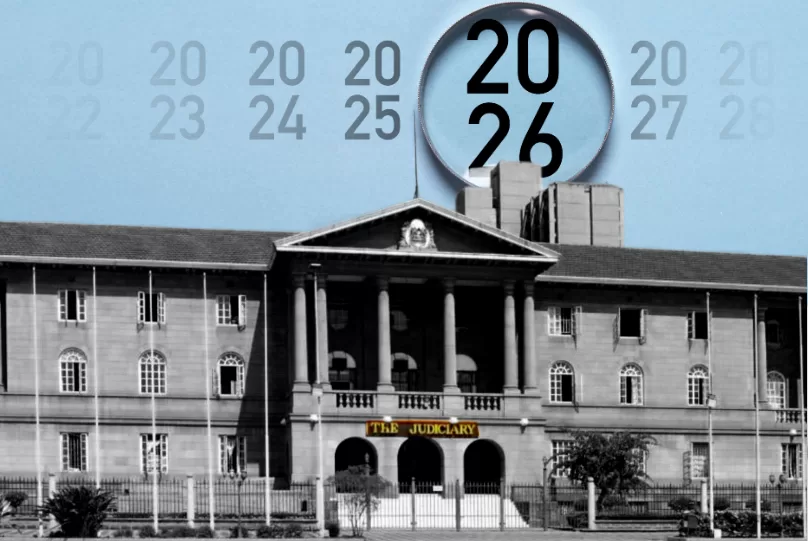
Looking back at 2025, the message is clear: Kenya’s courts were not just interpreters of law; they were central to the country’s democratic conversation. As 2026 begins, we can expect the Judiciary to remain a key arbiter of governance, balancing authority and accountability. In a year marked by protests, political tension, and questions of power, it was often in the courtroom that the clearest interpretation of the Constitution was heard.
In 2025, the Constitution spoke; and it spoke most firmly from the Bench. As we look forward, the country will continue to watch how the law shapes both leadership and citizen engagement, proving that the corridors of justice are more than gavel and paper, they are the stage where the nation’s values are tested and defined.